Configure Risk Elements and Assign to a Template
Risk Reviews are important in determining the risk that might exist for a deal. A number of items (elements) are considered when evaluating the amount of risk a deal can have without being in jeopardy of recapture. Risk reviews are performed quarterly to stay on top of any issues that may arise during the lifecycle of the deal. Different elements are evaluated based upon the phase of the deal.
ProLink has configured AHIC Risk Elements for those organizations that follow that model. If your organization does not follow the AHIC model, you can configure any other Risk Elements.
Note
For detailed information about Risk Elements in ProLinkAIM and how they relate to AHIC Guidelines, download the Risk Element Matrix.

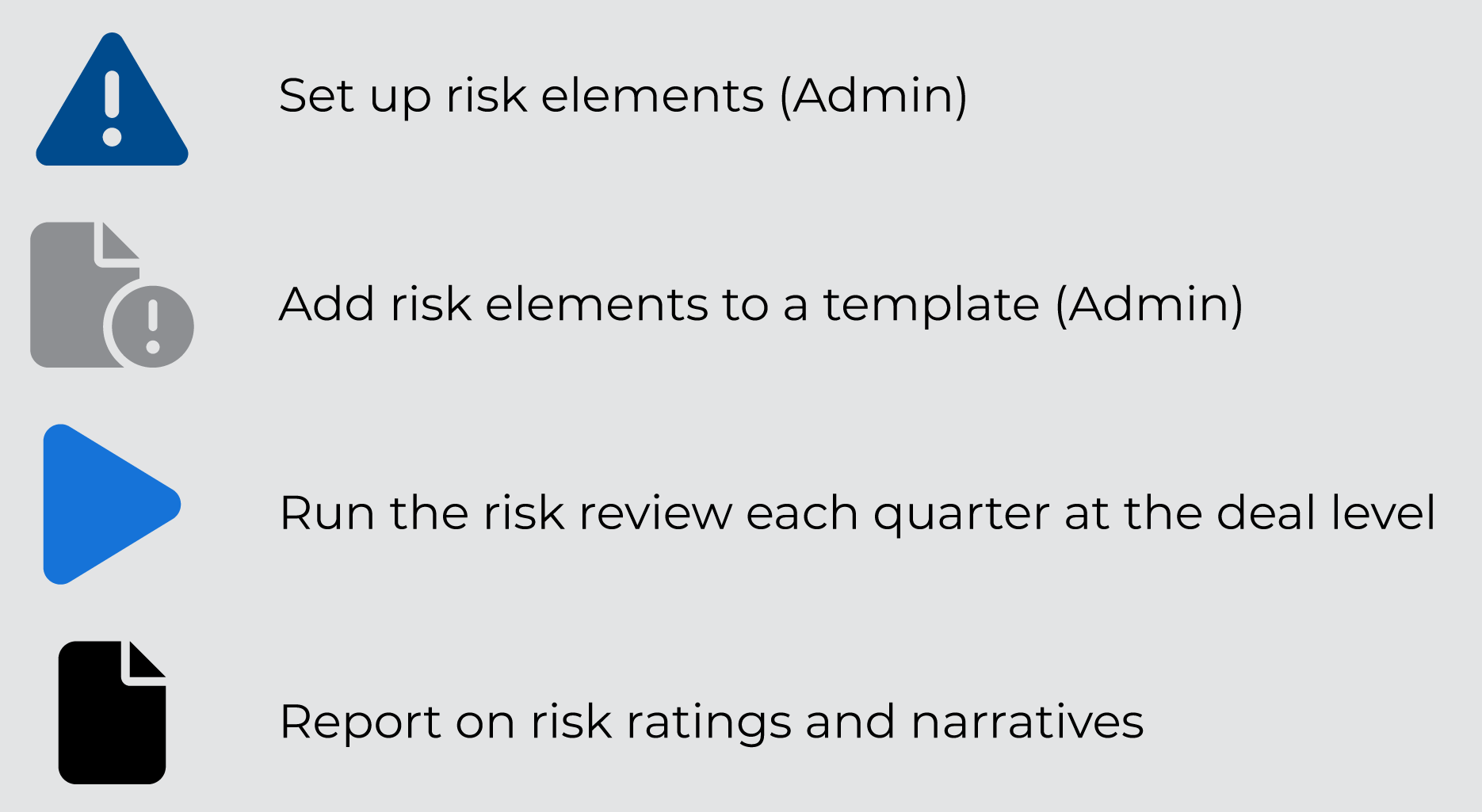
Set up risk elements—Your organization will create, update, and maintain Risk Elements through the Admin panel.
Note
Typically, ProLink helps set up Risk Elements during implementation, after which time you should not need to adjust them.
Add risk elements to a template—Your organization will add relevant Risk Elements to each Template through the Admin panel. A template is based on deal type.
Run the risk review each quarter at the deal level—Each quarter, you will run the Risk Review at the individual deal level. The system suggests a rating and provides the template narrative, which you can edit and finalize.
For information about Risk Reviews at the deal level, see Risk Reviews.
The New Year Process utility creates four quarter records for every deal across the system. For more information about the New Year Process, see New Year Process.
Report on risk ratings and narratives
Various quarterly reports
Risk Reviews data view
Deal data views (Overall Risk Rating column shows the latest Risk Rating)
Deal Overview screen (Deal Risk Rating field shows the latest Risk Rating)
Lower Tier Deals screen (Funds) (Current Risk Rating of each deal that belongs to the fund)
The Template Risk Elements menu option in the Admin panel allows you to create and activate Risk Elements, which you can then assign to a template(s) so that the system will bring relevant Risk Elements into deal-level Risk Reviews. You need to add Risk Elements to a template(s) before you can apply them at the deal level during risk reviews.
For information about Risk Reviews at the deal level, see Risk Reviews.
Risk Elements are categorized into the following evaluation types:
Stored Procedure—Runs system-driven logic and provides a result.
Manual—Provides options for you to select from manually.
Boilerplate—Provides template text inserted into Issues and Actions sections under the Risk Elements tab on the Edit Risk Review screen.
The following table provides examples of system (stored procedure) Risk Elements configure to follow the AHIC model. This list is not exhaustive of all Risk Elements in ProLinkAIM. For a more comprehensive list, see the Risk Element Matrix.
Risk Element | System Evaluation Description |
|---|---|
Debt Coverage Ratio | When the value from the following calculation from the corresponding period financial is: Calculation—(NOI minus Current Year Required Annual Amount (Reserves))/Hard Debt Principal plus Hard Debt Interest NoteThe Current Year Required Annual Amount is on the replacement reserves record.
|
Economic Occupancy | When the Economic Occupancy value from the corresponding periodic financial is:
|
Expense Coverage Ratio | When the Expense Coverage Ratio from the corresponding periodic financial is:
|
Reserves | When the RR Funded value from the corresponding periodic financial is:
|
The system administrator creates and maintains Risk Elements through the Risk Element menu option under Templates in the ProLink Admin panel. When creating Risk Elements , the administrator associates them to a Deal Type and Applicable Status. The Risk Element will only be evaluated when the Deal matches that Deal Type and the Status of the Risk Review record matches the Applicable Status of the Risk Element. Not all Risk Elements are evaluated for every deal.
When the administrator creates the Risk Element, they create the Issues and Actions text for the element. Then when the Risk Element applies for a deal's Risk Review, the corresponding Issues and Actions text is displayed.
Begin by creating and activating Risk Elements for your organization.
Note
Typically, ProLink helps set up Risk Elements during implementation, after which time you should not need to adjust them.
Navigate to the Templates Risk Elements option in the ProLink Admin panel.
The List Template Risk Elements screen opens.
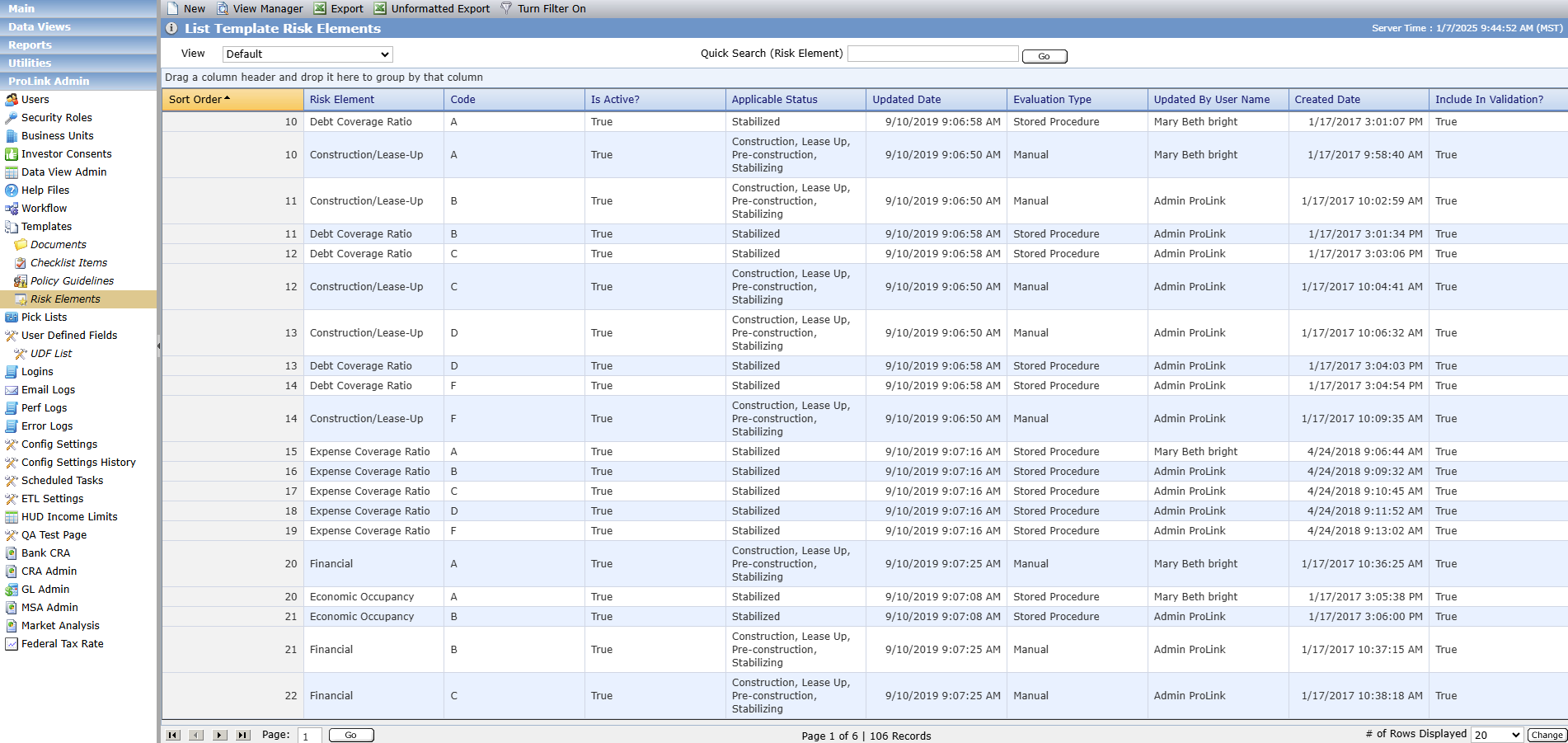
Click New in the top toolbar.
The Edit Template Risk Element screen opens.
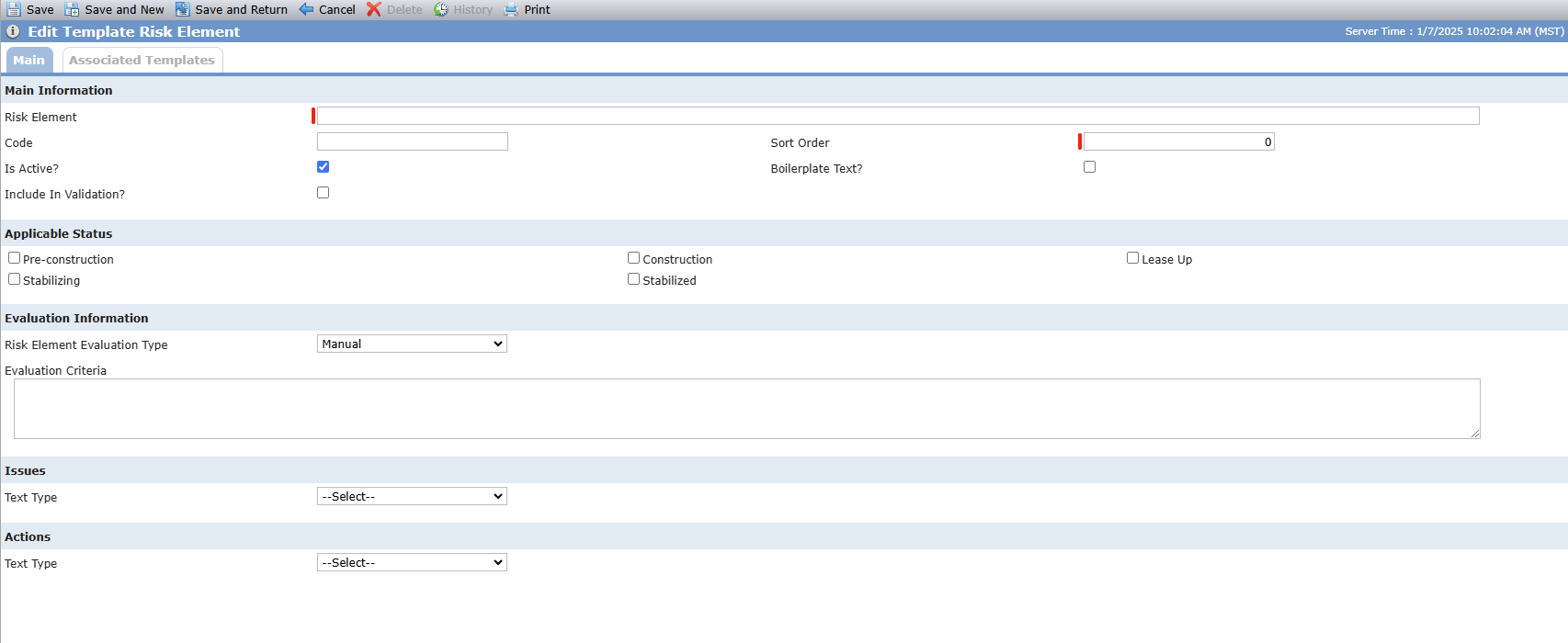
Enter a name for the Risk Element.
See Risk Element Groups for information about creating risk elements with the same name.
Enter the Code, such as "A".
Enter the Sort Order.
The Boilerplate Text checkbox is cleared by default, and the Evaluation Information section is available for you to define the evaluation criteria and text for the Risk Element. Select the Boilerplate Text checkbox to hide the Evaluation Information section and use the system's template text for the Risk Element.
Select the Include In Validation checkbox to require the Risk Element be evaluated.
If this checkbox is selected, this Risk Element must be added to the Risk Elements grid on the deal's Edit Risk Review screen. Otherwise, you will get an error if you try to change the Review Status to "Complete" without the required Risk Elements being added/evaluated.
Select the Applicable Status checkbox(es).
AHIC Guidelines apply to two phases: Development and Stabilized. In ProLinkAIM, the Applicable Status (system picklist PL_RiskStatus) is further divided into five statuses: Pre-Construction, Construction, Lease Up, Stabilizing, and Stabilized.
AHIC Development = ProLinkAIM Pre-Construction, Construction, Lease Up, Stabilizing
AHIC Stabilized = ProLinkAIM Stabilized
For each Risk Review for a selected deal, you will select the Status based on one of these options. All Risk Elements that exist on the deal's template with the same Applicable Status will apply to the deal's Risk Review.
If the Evaluation Information section is displayed, select "Manual" or "Stored Procedure" for the Risk Element Evaluation Type.
If the Evaluation Information section is displayed, enter a description of the Evaluation Criteria.
If the Evaluation Information section is displayed and "Stored Procedure" is selected, enter the name of the Validation Stored Procedure.
ProLink is available to help with setup of Stored Procedure Risk Elements.
The Stored Procedure will be suffixed with "_Validation" and return a boolan.
In the Issues Text Type list, select "Static Text" or "Stored Procedure".
In the Issues field, enter the text that will be displayed under the Risk Elements tab on the Edit Risk Review screen.
OR
In the Issue Stored Procedure field, enter the name of the Stored Procedure that controls what is displayed for the Issues text.
The Stored Procedure will be suffixed with "_Issue" and return a string.
In the Actions Text Type list, select "Static Text" or "Stored Procedure".
In the Actions field, enter the text that will be displayed under the Risk Elements tab on the Edit Risk Review screen.
OR
In the Action Stored Procedure field, enter the name of the Stored Procedure that controls what is displayed for the Actions text.
The Stored Procedure will be suffixed with "_Action".
Click Save.
Risk Element Groups
You can group Risk Elements using the same Risk Element name. The system treats the grouped elements as one regarding the Included in Validation logic.
For example, these five Risk Elements are grouped with the same name.
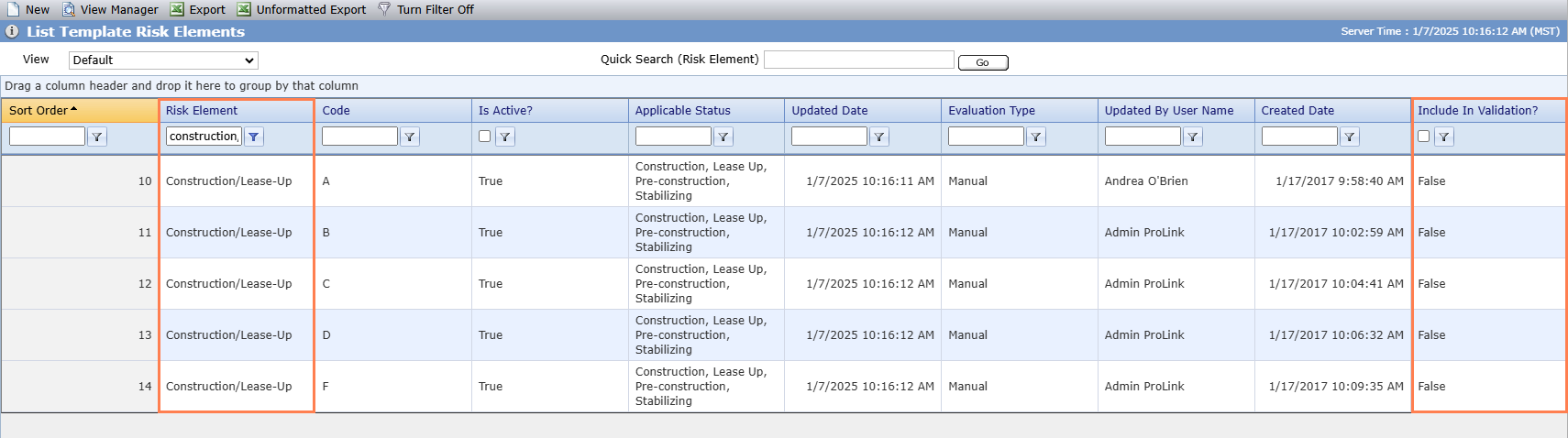
Open any of the Risk Elements. Select the Include in Validation checkbox and save.

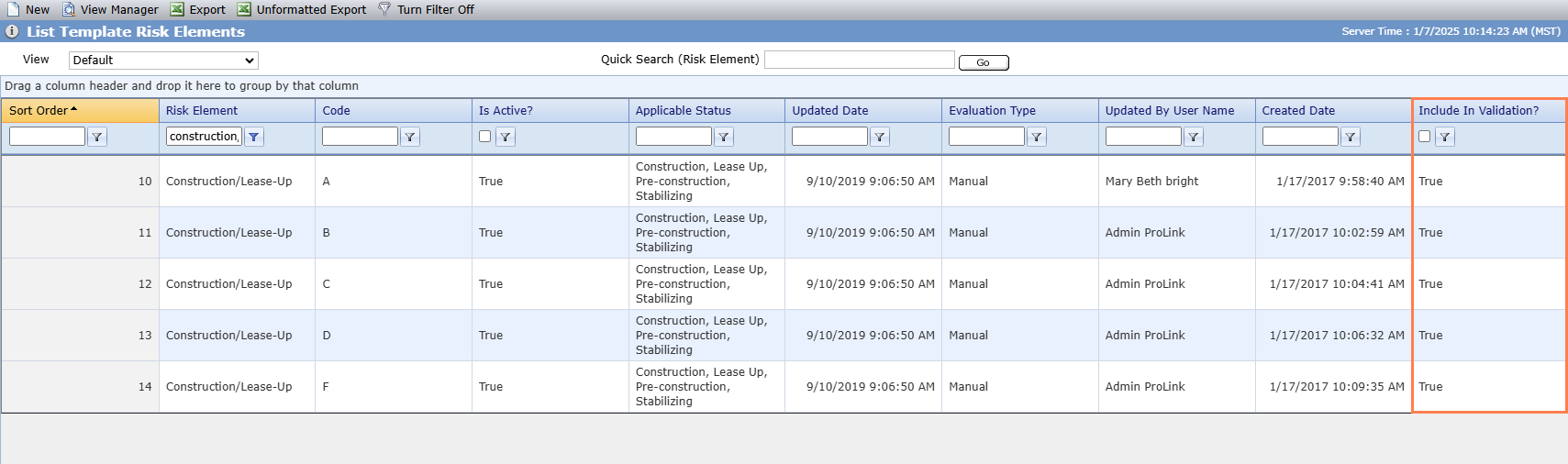
Notice that the other four Risk Elements are also included in validation.
After you have configured Risk Elements for the organization, you will need to attach them to a template(s).
Navigate to the Templates option in the ProLink Admin panel.
The List Templates screen opens.
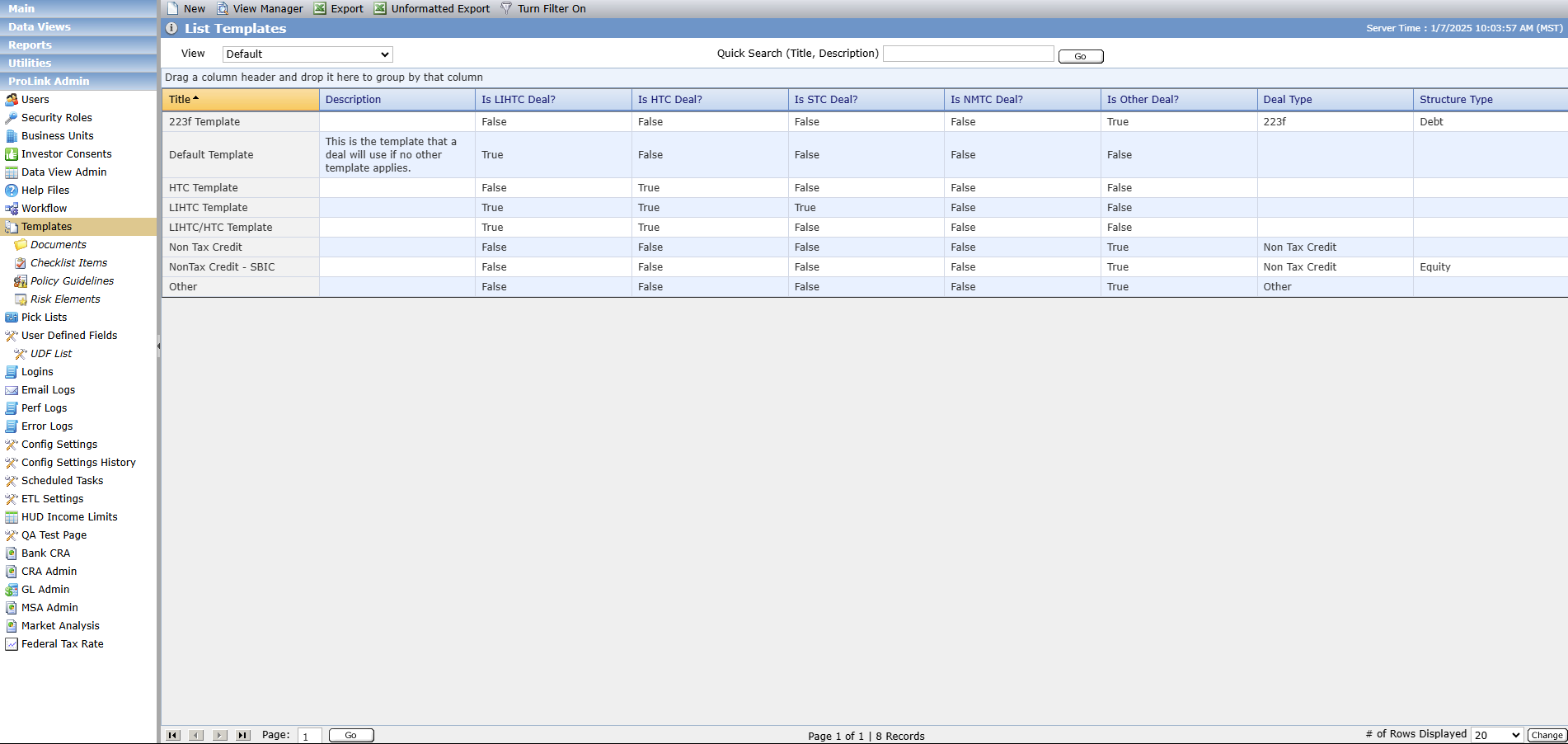
Select the template to edit.
The Edit Template screen opens.
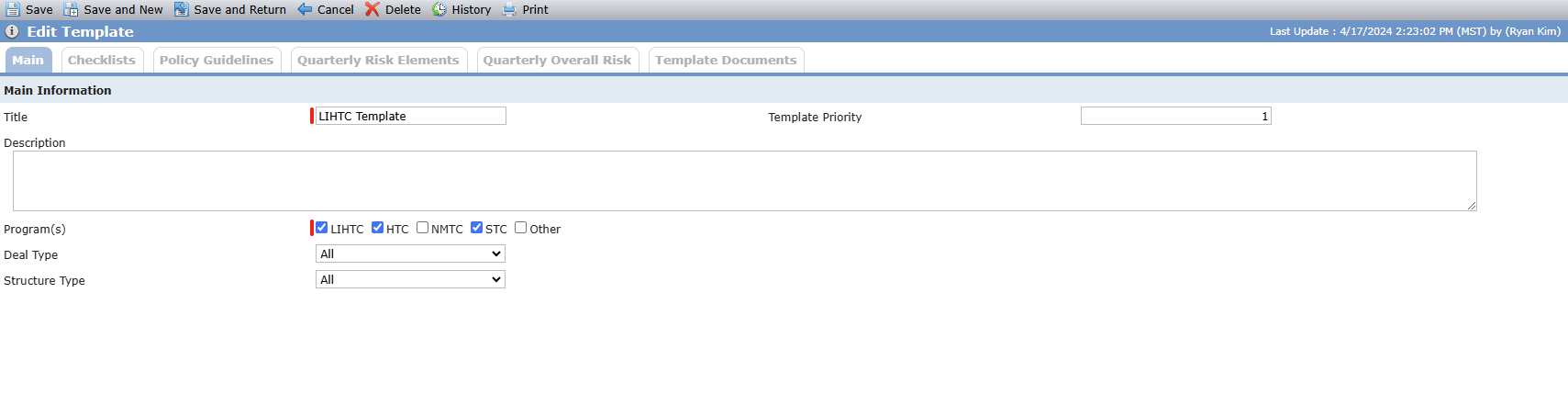
Click the Quarterly Risk Elements tab.
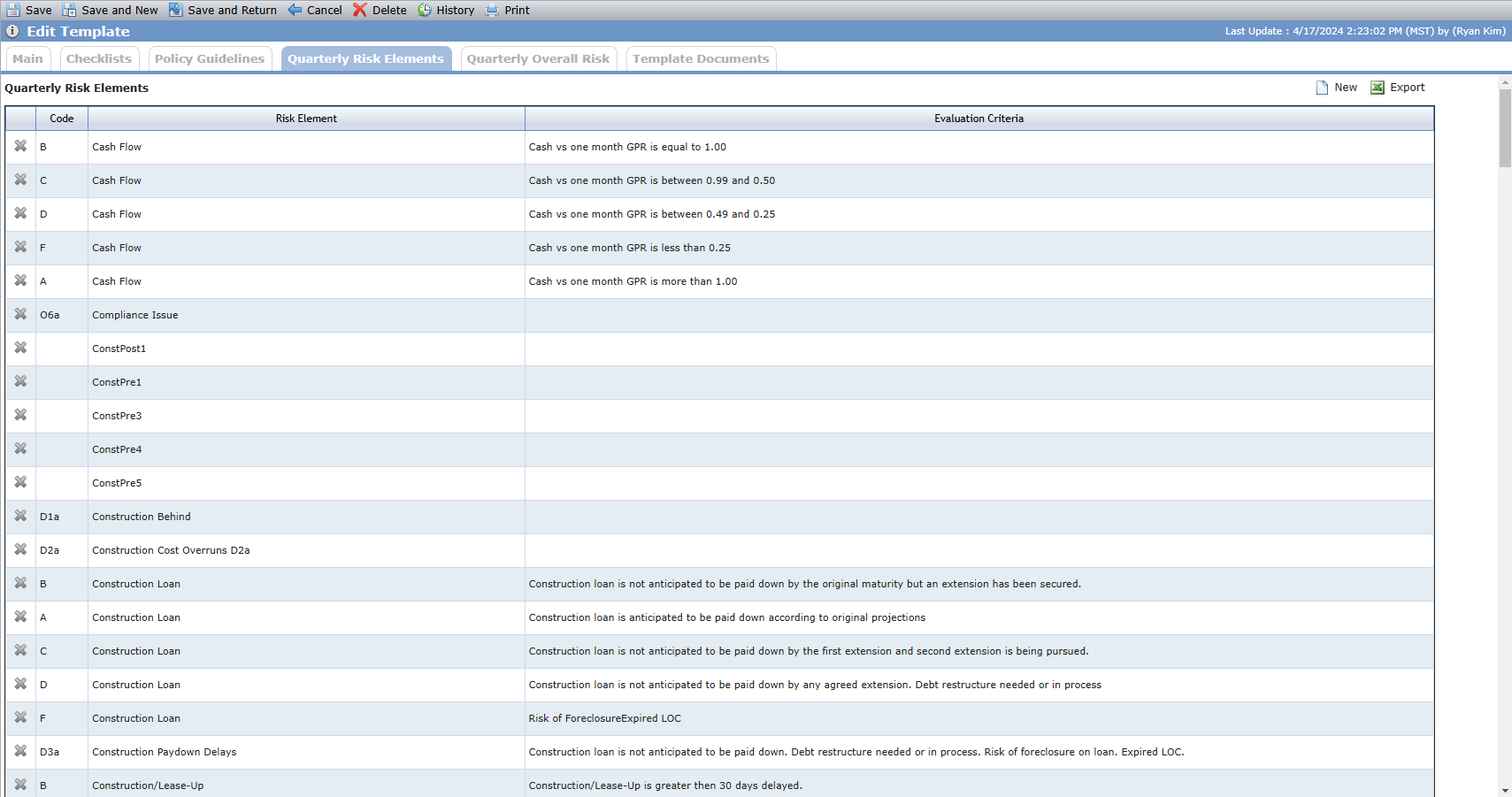
Click New above the Quarterly Risk Elements grid.
The Find Risk Elements popup opens, populated with all configured Risk Elements that have not yet been attached to the template.
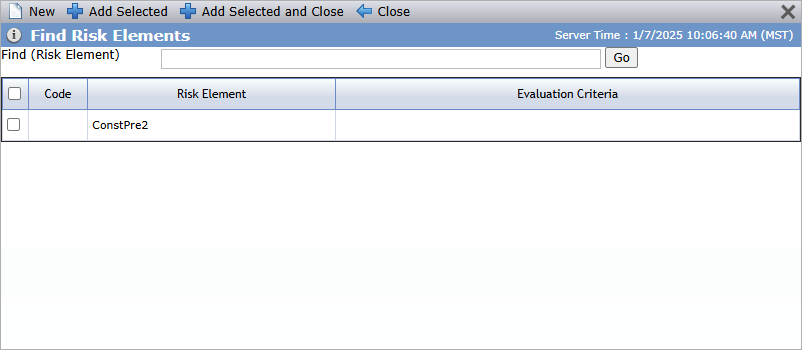
Select the checkbox(es) of the Risk Element(s) to attach.
Click Add Selected and Close.
Click Save.
Note
To remove a Risk Element from a template, click  in the row of the Risk Element on the Quarterly Risk Elements tab, and then click OK to confirm the deletion.
This section provides examples of system (stored procedure/boilerplate) Risk Elements you might see in ProLinkAIM. This list is not exhaustive. For a more comprehensive list, see the Risk Element Matrix.
Risk Reviews can be configured to include Physical Occupancy data points captured on the Occupancy screen. For more information about Occupancy, see Occupancy.
Risk Element | Evaluation Type | Description | Validation Stored Procedure | Template Text for Issues | Template Text for Actions |
|---|---|---|---|---|---|
Physical Occupancy < 92% | Stored Procedure |
| resp_IssueFixOccupancy_Validation | Stored Procedure: resp_IssueFixOccupancy_Issue Text: “Two of the 20 units were vacant.” | Static Text; customized by the client |
StabIss3 | Boilerplate |
| N/A | Stored Procedure: resp_StabIss3_Issue Text: “Physical occupancy at the end of the fourth quarter was 90%.” | Static Text; customized by the client |
Risk Reviews can be configured to include Unit Mix data points captured on the Unit Mix screen. For more information about Unit Mix, see Unit Mix.
Risk Element | Evaluation Type | Description | Validation Stored Procedure | Template Text for Issues | Template Text for Actions |
|---|---|---|---|---|---|
StabSent1 | Boilerplate |
| N/A | Stored Procedure: resp_StabSent1_Issue Text: “Actual rent for 1 bedroom units was above original projections by 25%. Actual rent for 2 bedroom units was within 10% of original projections.” | Static Text; customized by the client |
Risk Reviews can be configured to include Reserve data points captured on the Financials screen. For more information about Financials, see Financials.
Risk Element | Evaluation Type | Description | Validation Stored Procedure | Template Text for Issues | Template Text for Actions |
|---|---|---|---|---|---|
ReplRes1 | Stored Procedure |
| resp_ReplRes1_Validation | Stored Procedure: resp_ReplRes1_Issue Text: “Replacement reserves are over funded with a balance of $20,000.” | Static Text; customized by the client |
OpsIss7 | Stored Procedure |
| resp_OpsIss7_Validation | Stored Procedure: resp_OpsIss7_Issue Text: “The operating reserve has a balance of $270,000.” |
Risk Reviews can be configured to include Guarantee data points captured on the Guarantees screen. For more information about Guarantees, see Guarantees.
Risk Element | Evaluation Type | Description | Validation Stored Procedure | Template Text for Issues | Template Text for Actions |
|---|---|---|---|---|---|
OpsIss5 | Stored Procedure |
| resp_OpsIss5_Validation | Stored Procedure: resp_OpsIss5_Issue Text: “The property has an operating deficit guaranty which expires in December 2025, with a limit of $1,000,000.” | Static Text; customized by the client |
Let's look at an example.
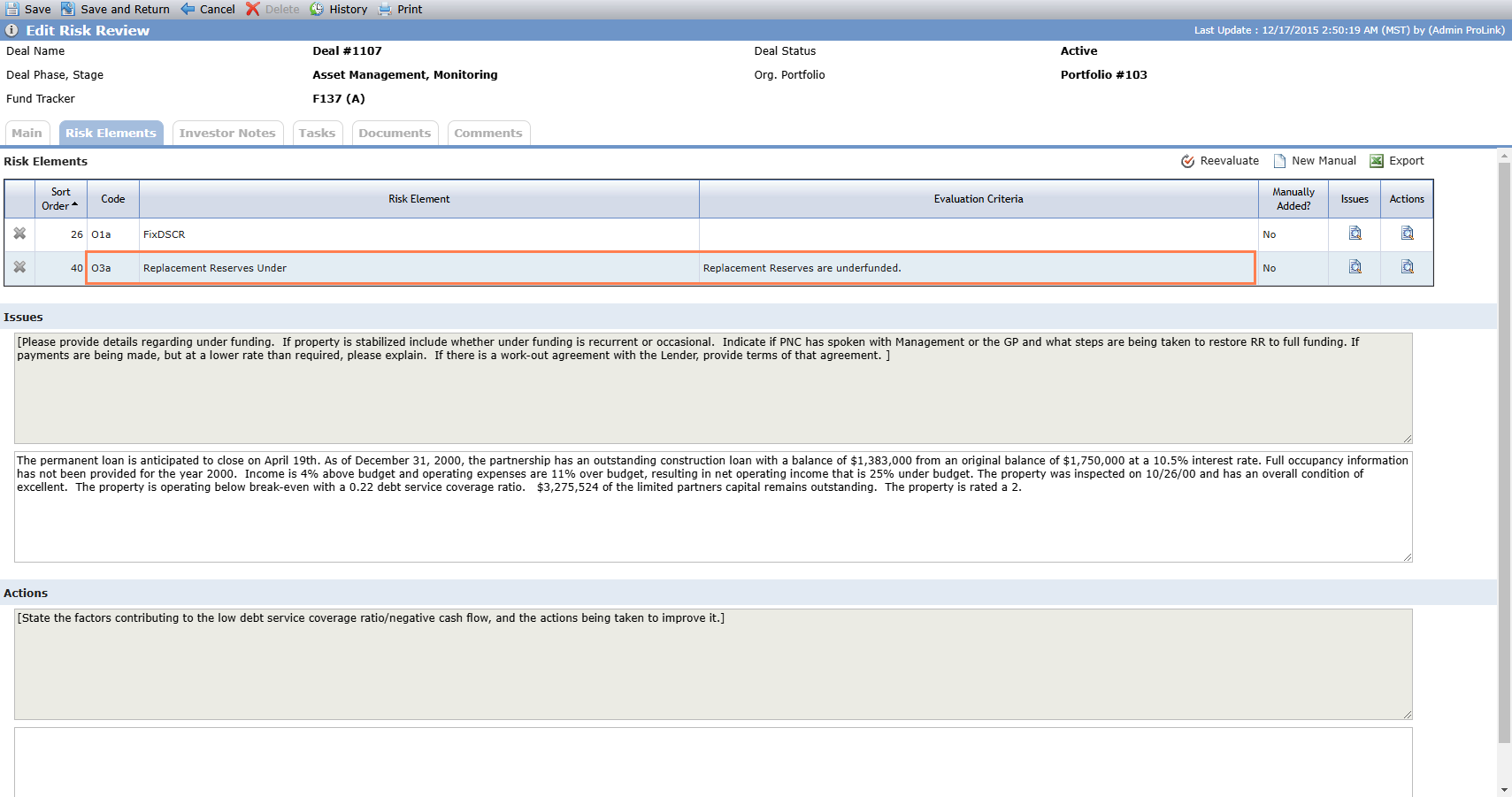
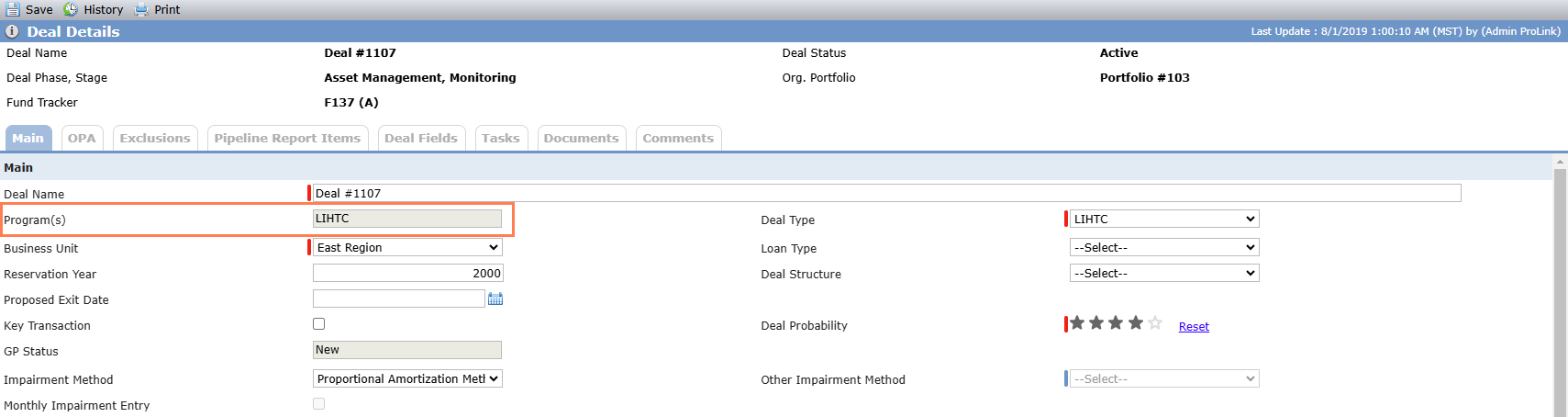
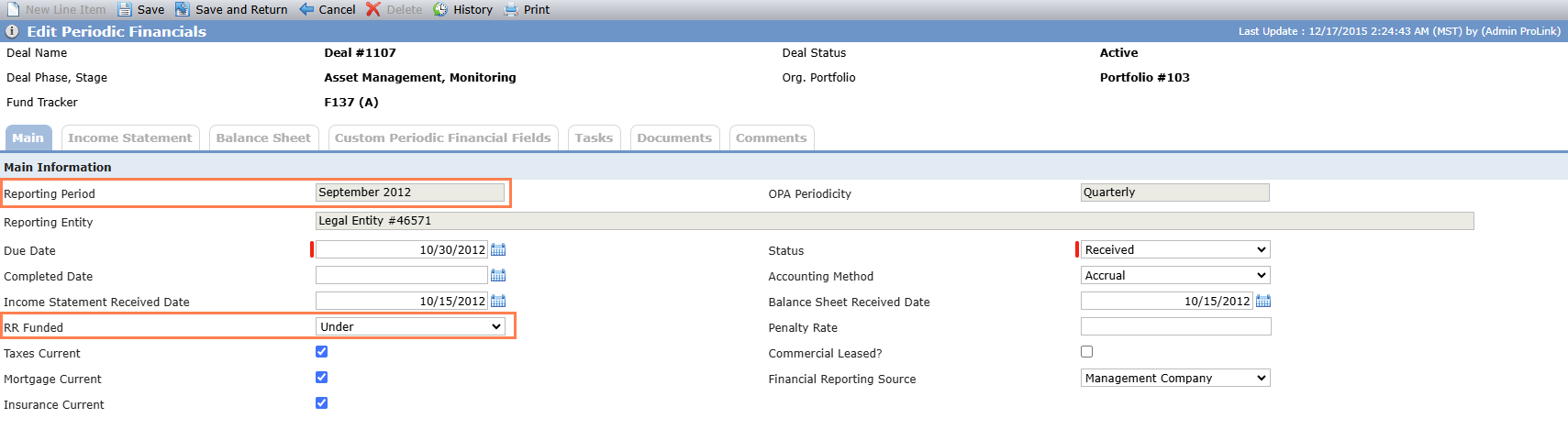
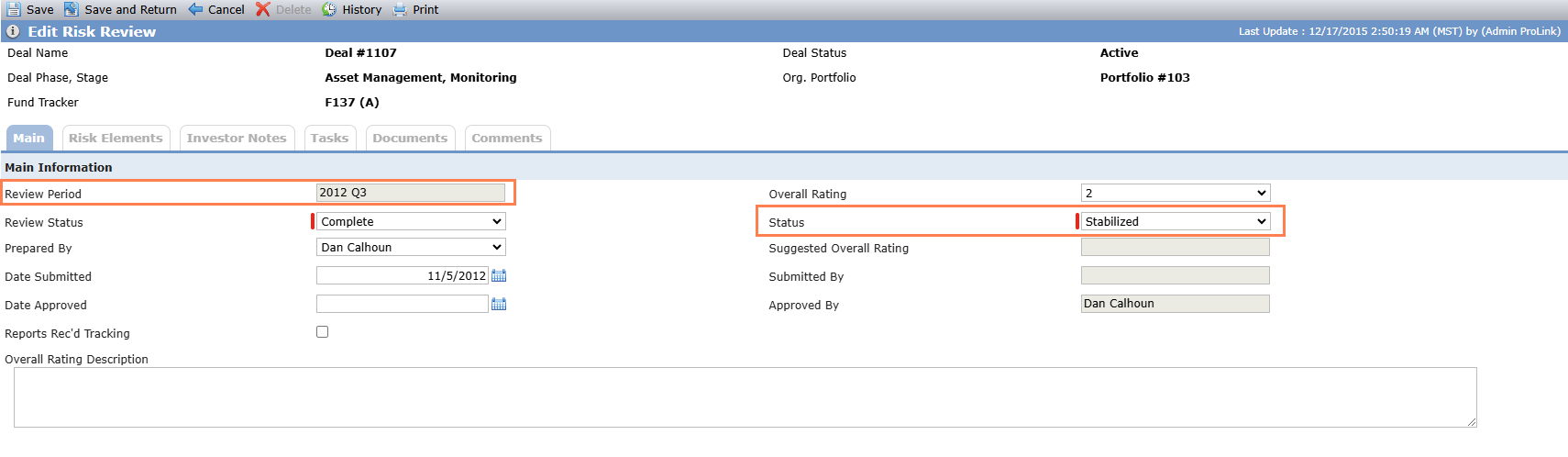
The administrator has configured the Risk Elements in ProLink Admin. One of the Risk Elements is Code O3a (Replacement Reserves Under), which is a system (stored procedure) Risk Element that checks the value of the RR Funded field on the Edit Periodic Financials screen - Main tab for deals with the Status of Stabilizing or Stabilized.
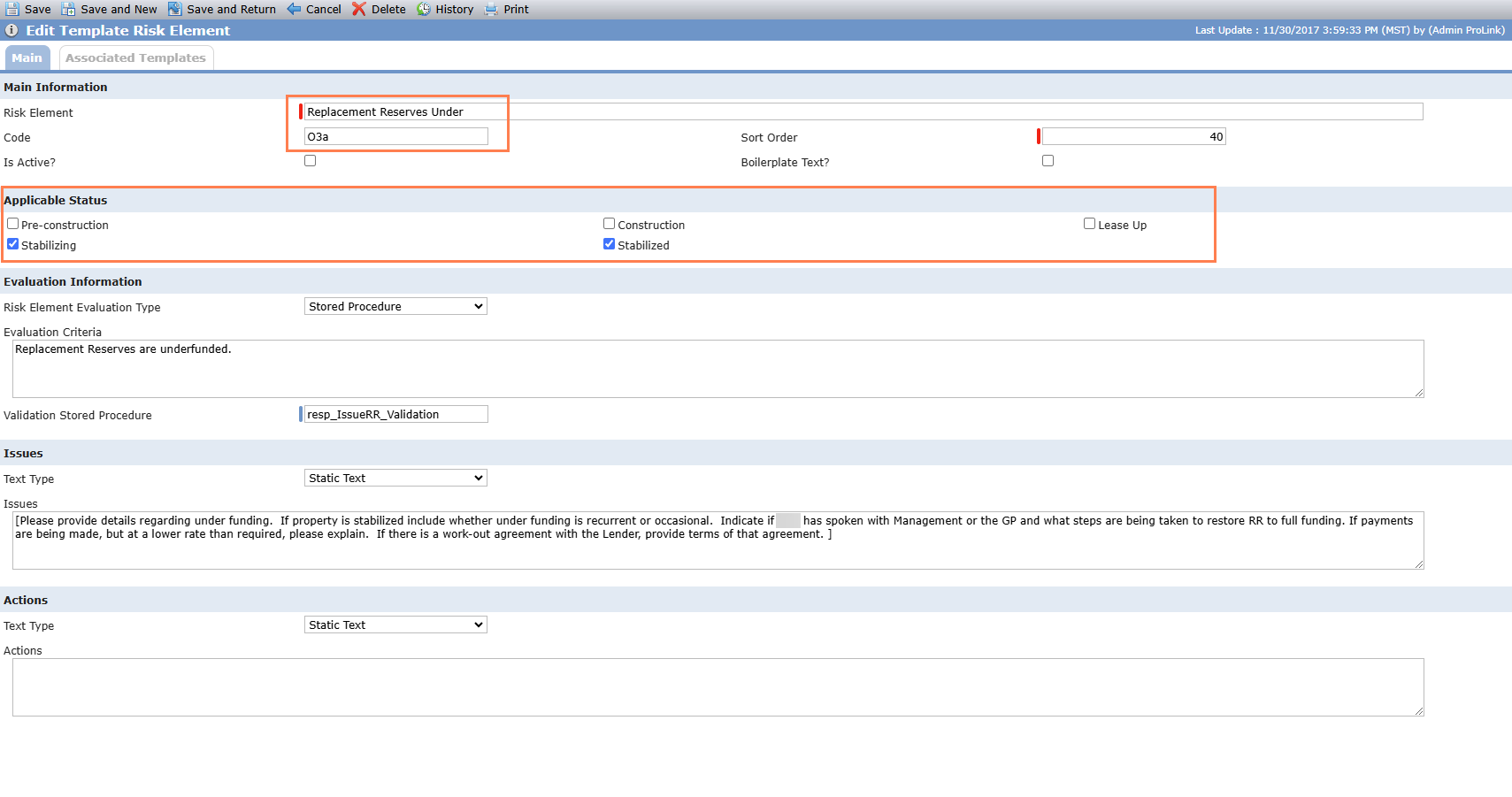
The administrator associated the Risk Element with the LIHTC Template.
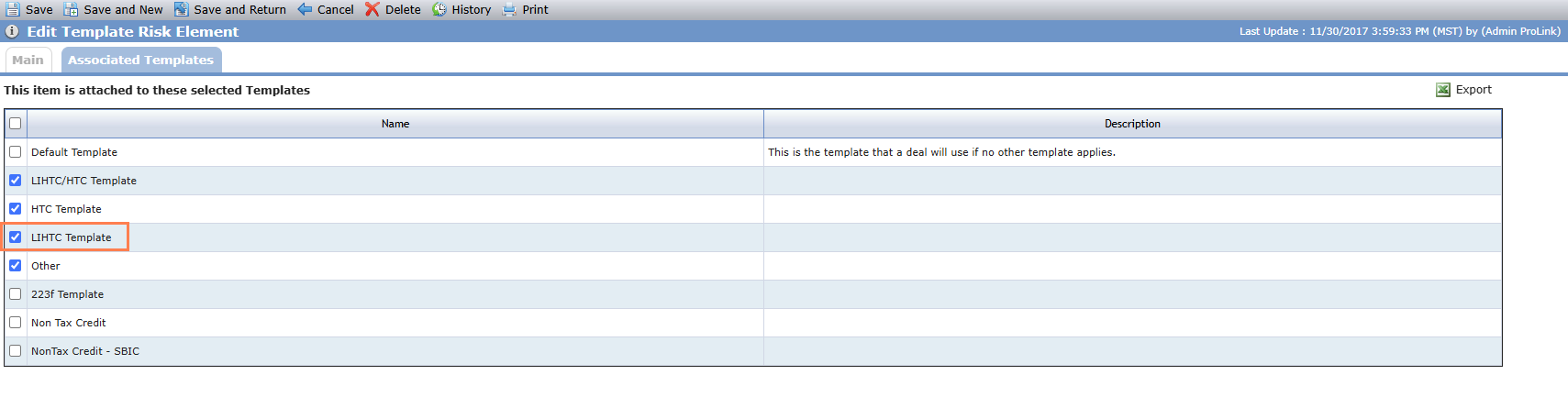
Now we can look at a particular LIHTC deal.
The RR Funded field is "Under" for the Reporting Period of "September 2012."
The Risk Review for the Review Period of "2012 Q3" is in a Status of "Stabilized."
One of the systematically identified Risk Elements is O3a (Replacement Reserves Under). The Asset Manager can review the system-populated Issues and Actions text for the Risk Element and then enter their own comments to address the Risk Element for the deal.